Showing posts with label build a following. Show all posts

Monday, 2 March 2015

6 Steps to Building a Loyal Online Audience

Are you looking for ways to build a loyal online audience? Do you know what a loyal audience can do for your business?
 
To be successful online you’ll need a group of brand advocates who will help to push your business forward. Those that will read your posts, share your content and recommend you to their friends, family and colleagues.
 
To help build that audience QuickSprout have put together their 6 steps in the infographic below.
 
6 Steps to Building a Loyal Online Audience


Friday, 27 February 2015

Google Plans to Index Tweets in Real Time: How This Could Impact Your SEO

twitter-google-search-results
 
Years ago, it was commonplace to find real-time tweets in Google Search results. Twitter and Google had inked a deal that gave the search giant access to the social network's data stream. In turn, Google would display tweets in search results in real time. But that agreement expired, and in the middle of 2011, Google lost access to Twitter's data stream. 
 
Now, nearly four years later, the gang's back together.
Recently, Google and Twitter announced that they are working together again to index tweets as soon as they are posted.
 
How should a marketer to react to this news? In this post, I will focus on how you can benefit from the new deal between Google and Twitter. You will need to be active on Twitter to obtain these benefits, but I will include some tips for those of you who are just getting started -- you can still benefit from this development if you're doing the right things. The good news is that it will take some time for Google to implement changes based on the new data they will be getting from Twitter, so you have some time to get ready. But the sooner you get started, the better.
 
So let's dive into what the deal actually is and learn how you can take advantage of it.
 

What's the Deal With This New Deal?

 
Basically, this deal gives Google real-time access to tweets via a data feed, commonly called the Twitter Firehose. While the agreement seems to be in effect already, the two companies are saying only that it will take effect in Google Search sometime in the first half of 2015. The reason it will take some time to implement is that Twitter needs to figure out how to prep the data for Google, and Google needs to look at this data stream and decide what they want to do with it. However, one thing we know they will do is increase the number of tweets that they are indexing. What that means is that your tweets could start showing up in the search results.
 
Google actually does show some tweets in its search results today, but it's only a very small portion of what's on Twitter. My company, Stone Temple Consulting, recently did a study of 133,000 tweets to see how Google indexes tweets, and what we found is that Google indexes less than 8% of all the tweets we tested.
 
tweets-indexed-pie-chart
 
That's not a high level of indexation at all. To make matters worse, it also appears that Google is quite slow to index tweets, as you can see in the chart below:
 
tweet-indexation-by-day
 
Currently, that means tweets have little chance of getting indexed. In fact, the people whose tweets were most likely to be indexed, according to our study, had much higher than average followings. For people who are just starting out on Twitter, chances are that the indexation rate is near zero.
 
The new deal between Google and Twitter may well change all that. It's hard to predict just how many more tweets Google will index, but you can count on it being a significant change -- otherwise doing this deal makes no sense for Google.
 
As a result, you may have an opportunity to use Twitter to increase your presence in Google's SERPs. However, remember that Google will need a few months to implement changes to leverage the Twitter data feed, so don't expect instant results.
 

How Will Google Choose Which Tweets to Index?

 
Google has made no statements about what their plans are, so we don't know for sure. But, based on their history, we figure that Google is going to work hard to find the tweets that offer the most value to their audience. They will also most likely implement strong anti-spam measures.
 
While the new Twitter data feed will be valuable to them, frankly, it's an add-on. They will be conservative in what they allow into the results, and they will only include things that they have a very high degree of confidence are not spam.
 
As a consequence of that, trying to game this new arrangement will likely be very difficult to do. Google is going to look for signals that certain tweets have greater value. Here are the types of signals that could be available to them:
  1. Links from third party web sites to the tweets. (This signal is already available to them today.)
  2. Links from third party web sites to a user's profile. (This signal is already available to them today.)
  3. How many times a tweet is retweeted, and by whom. They may get this info directly from Twitter, or they may use their own means to determine it. (This will be new data for them.)
  4. How many times a tweet is favorited, and by whom. They may get this info directly from Twitter, or they may use their own means to determine it. (This will be new data for them.)
I don't see how this deal makes sense for Google unless they get the info on points 3 and 4 above, or at least number 3. This would mean that Google can use retweet data, and the knowledge of who is performing the RTs to determine which tweets have the most value. This is the source of where I see significant potential value for companies and publishers.
 
Maximize your engagement on Twitter, and you are sending out signals that your tweeted content is valuable. So how do you get more engagement?
 

How Should You Maximize Engagement on Twitter?

 
This was the subject of another study my company did recently on Twitter engagement. This particular study focused on what factors within your Twitter content cause increases in retweets and favorites. By far the most significant factor was the use of images in your tweets:
 
6-images-increase-rt
 
Here you can see that your chances of getting at least one retweet are more than doubled for most low and moderate social authority accounts. That's quite a significant difference. Our data also showed that you can also get five to nine times as many total retweets by including images. That's a big deal!
 
Other factors that matter, though not quite as much as images, were the use of hashtags and implementing longer tweets. Factors that mattered less were time of day, including links to content off of Twitter, or mentions of others.
 
While the above info can definitely help you optimize your own presence, you can't forget the importance of developing relationships on Twitter. Focusing on key friendships and relationships with influencers is a big key to success, especially if your presence on the platform is not currently that strong. 
 
Imagine someone with a highly influential account retweeting your most important content. This could be gold for you, as it can make Google aware of the content very quickly. The influencer's tweet with the link to your content may appear in search results and help expose it to much wider audiences. Of course, this may also result in more links to your content as well.
 
Even if Google does not get information in the Twitter data feed that allows it to understand who is retweeting whom, Google could still use link data to better understand whose profiles are most important. Then, they can place more value on their tweets, and place them within their index, driving traffic and exposure to that tweet. If it contains a link to your content, your traffic and exposure could go up.
 

Summary

 
Will this fundamentally alter the digital landscape? No, but it does mean that a strong presence on Twitter will have more value than it did before. To capitalize on this shift, do the following:
  1. Increase your time invested in Twitter.
  2. Create engaging content that people will want to retweet and favorite.
  3. Build relationships with others who will help amplify your content.
  4. Make sure to build relationships with influencers whose tweets are more likely to get indexed by Google.
  5. Watch the indexation of your tweets grow while you build your own influence on the platform.
As the full partnership takes effect, we may discover other ways to optimize our Twitter strategies for search, but until then, preparing for the shift using the steps above is a wise move.


Monday, 23 February 2015

LinkedIn Marketing: 8 Huge Benefits and 8 Awesome Tips to Master It

Ae you using LinkedIn as a platform to market your business? Do you need convincing about its benefits and want some tips to get started?
 
If you’re a B2B company LinkedIn is an absolute must, but that’s not to say a B2C company can’t achieve success too. LinkedIn offers a unique platform to build brand awareness amongst a targeted professional audience.
 
QuickSprout have put together this infographic showing the benefits of LinkedIn and some tips on how to implement your strategy.
 
LinkedIn Marketing 8 Huge Benefits and 8 Awesome Tips to Master It


Friday, 20 February 2015

How To Grow A Business To $100 Million In Sales, From Someone Who's Done It Twice

Zeta Interactive CEO David A. Steinberg has lived through remarkable success and failure alike as a serial entrepreneur and executive. In his 20-year career, he's learned hard lessons that have made him wiser, more effective, and especially more prudent, he tells Business Insider.
 
Zeta Interactive CEO David Steinberg
 
Steinberg jumped into the growing cellular-phone industry a year out of college, founding the retail chain and business-to-business provider Sterling Cellular in 1992. He then founded the telemarketing company Sterling Communications, which he sold in 1999 along with his retail business, starting online cellular commerce and business-to-business company InPhonic that same year.
 
At its height, Steinberg says, InPhonic was bringing in approximately $400 million in revenue. In 2004, it was named the fastest-growing private company in the US by Inc. magazine and went public that same year. By 2007, however, it was in bankruptcy due to mismanagement and a host of other factors.
 
He quickly moved forward, founding the digital marketing firm that was rebranded this year as Zeta Interactive with his business partner John Sculley, former PepsiCo president and Apple CEO. Steinberg tells us that Zeta brought in revenue of $90 million last year and that it's already passed $100 million this year. He projects year-over-year growth of 90% and says its operating margin is in the mid-teens and rising, meaning that Zeta is on a healthy, fast-growth path.
 
Here are some powerful growth lessons Steinberg says he's learned from being at the top to being at the bottom and how they are helping him today:
 

Set Up People and Processes for Sustainable Growth.

 
One of the reasons InPhonic ultimately failed is because it grew too quickly, Steinberg says. It went from offering 100,000 phone rebates to customers to offering 1 million in the span of a year — and the company simply wasn't ready to handle it, both in terms of manpower and technology. Customer service began to suffer significantly due to the inability to adapt, and Steinberg tells us that rebate turnaround times increased from one month to six months.
 
Looking back, Steinberg says he should have eased the company into a more manageable direction, in addition to replacing certain employees that were not good fits for a new direction. "The people who got you to where you are won't always get you where you need to go," he says.
 
At his current company Zeta, Steinberg says he has chief information officer Jeffry Nimeroff focus on making sure that the company's technology is always able to handle Zeta's growth. By using a data-based growth strategy, Steinberg is able to avoid unnecessarily risky initiatives that the company may not be able to adapt to.
 

Hand Off Responsibilities.

 
"It took me 20 years to realize I'm not the best at everything," Steinberg says, laughing.
 
For example, he says that 15 years ago he wouldn't have been able to effectively manage his current chief operating officer, Steve Gerber, because he wouldn't have been able to hand off day-to-day management decisions to him.
 
Steinberg says that he's learned that to increase your chances of developing leaders within your own company, it's necessary to hire very intelligent people for your team. "You can teach smart people to do almost anything," he says.
 

Pivot Every Six to Nine months.

 
Steinberg thinks that a high-growth company needs to constantly reinvent itself to stay relevant, and that doesn't necessarily mean that it needs to go in a radical new direction.
 
Zeta started in the education sector before pivoting over to big data marketing solutions, and it's worked out well.
 
He says that as head of InPhonic he should have acquired an outside wireless company to keep InPhonic interesting and able to handle accelerated growth.
 

Never Put Yourself in a Situation You Can't Get Out Of.

 
On that note, Steinberg says he made the mistake of setting self-imposed limitations on what InPhonic could be. Part of this had to do with his former obsession with getting press for InPhonic when it was still young, which resulted in excessive coverage of certain initiatives he should have dropped when they stopped working.
 
This time around with Zeta, he focused on finding what worked before reaching out to the media. He says that today it's "the biggest tech company in New York that no one's heard of." It's better to figure out a growth strategy under the radar than limiting your ability to change course, he says.
 

Don't be Afraid to Let the Market Come to You.

 
"Most startups wait to start in a time that's hot for their industry," Steinberg says, but that's not necessarily the best option. If you sit on an idea and wait for the market to open its arms to it, then you risk reaching an opportunity for scaled growth at a time when that particular market cools.
 
If you happen to have a great idea, Steinberg recommends building a company regardless of what the market is doing. And if that great idea turns out to be a great company, then you can still find an audience.
 
Similarly, Steinberg says, he's never started a company with an exit strategy, as some serial entrepreneurs do. "The exit will find you," he says.
        
http://www.businessinsider.com/david-steinberg-how-to-build-million-dollar-company-2014-9?IR=T

Wednesday, 18 February 2015

How to Write an Irresistible Headline

Let’s start with a fundamental question: How are posts shared?
 
It’s not the blog post, tool, or resource that gets shared. That might be what motivates the person who is sharing it, but all that ends up getting shared is the headline. The headline is what you share with your subscribers, it’s what people see in search results, and it’s what gets passed around
.
It doesn’t take a genius to figure out that a good headline is going to help your traffic prospects.
 
What’s less obvious is that sometimes the best way to come up with an idea is to start with the headline. Here’s why: If you start with the resource, you might end up putting a lot of time into it before you realize that there’s no way to summarize it with an irresistible headline. This is a lot like the death sentence most products face if they don’t have an “elevator pitch” on which to build.


What Makes a Good Headline?

 
According to a study published in The Guardian, these changes help your headline’s click-through rate:1
  • Headlines with 8 words do 21% better than average.
  • Using a hyphen or colon will add 9% to your CTR.
  • Thumbnails and images boost clicks by 27%, so use them on every platform you can.
  • List posts tend to do better. They do even better if the number of list elements is odd instead of even. In fact, odd-numbered posts do 20 percent better than even-numbered posts. I suspect, however, that “10” is an exception to this rule.
  • Headlines that end with a question mark do better according to this study. On top of that, a university study has also found that question headlines do better. They also discovered that question headlines did even better if they referenced the reader with “you” or “your,” as opposed to rhetorical questions or other types of questions.
  • Headlines that end with three exclamation points get twice as many clicks as headlines with any other punctuation!!! Obviously, you can do this too much!!! You’ll start to lose your credibility after a while!!! But if you’re going to use an exclamation point, you might as well use three instead of one!!!


What Do the Top Blogs Do?

 
Using a script, Startup Moon scraped several blogs and organized the posts from most to least shared on social networks. This doesn’t necessarily mean that they are the most shareable headlines, but it’s probably a good indication that these posts attracted more traffic than usual. Posts in the top 20% tended to use the following tactics:
  • Startup Moon was looking at tech blogs, but some of the most successful posts used words like “kill,” “fear,” “dark,” “bleeding,” and “war.” It looks like violent language gets attention, even when the subject isn’t about violence at all.
  • The negative spin on a post tends to do better. Words like “without,” “no,” and “stop” showed up in a lot of the top posts. A study by Outbrain reached a similar result. They found that the negative superlatives “never” and “worst” performed 30% better than average and 59% better than positive superlatives. I’d bet that this all comes down to the human bias called loss aversion. Even when the outcome is the same, we pay more attention when the outcome is framed as avoiding a loss instead of gaining something.
  • Obviously, people like seeing numbers in headlines. But it’s not just list posts that do this. Numbers of any kind apparently add credibility to headlines by adding specificity. Bigger numbers also tend to do better because they make things sound more dramatic. Use digits to represent numbers, not words. Time units also help, probably because they indicate exactly how much time it will take to learn something new. Finally, it’s best if the headline starts with the number.
  • Guides do very well. Using words like “introduction,” “beginner’s guide,” “in 5 minutes,” and “DIY” will help your CTR.
  • Piggybacking on big brands and hot topics also helps, even when the articles are only using those brands or topics metaphorically to make a comparison with something very different.
  • A few random words also seemed to help: smart, surprising, science, history, hacks/hacking/hackers, huge/big, critical.
  • The study also found that these words seem to hurt: announcing, wins, celebrates, grows.
 
Finally, if you want better headlines, your content needs to be built on a broader base of subjects and topics. This is where you look for inspiration from the top brands and widen your content strategy to include as many themes and ideas related to your industry as you can.
 
In another study, Ripenn analyzed 2,616 headlines on sites known for their ability to elicit clicks: BuzzFeed, UpWorthy, ViralNova, and Wimp. Here’s what they recommend as a result of their findings:
  • Reference current trends, celebrities, and popular movies but with a unique spin on them.
  • Inject headlines with curiosity. Elicit an interest, but don’t give it all away in the title.
  • Use emotional words.
  • Use action words. This is backed up by Dan Zarrella’s research on Twitter click-through rates. More adverbs and verbs will help CTR, while more nouns and adjectives will hurt it. We like to hear stories about things that are being done or learn how to do things. We don’t like stories about things just sitting there.
  • Make bold claims.
  • Write relatable, human headlines, and don’t get too formal.
 
Working together with Ripenn on that study, BufferApp was able to discover that these were some of the most popular phrases in successful headlines:
 
Image via BufferApp
Image via BufferApp
Image via BufferApp
Image via BufferApp


What If You Just Want to Sell?

 
While these are great tactics for sparking interest in a subject, many of them will backfire if you’re trying to target users who are already looking for something specific. Several case studies from ContentVerve at Unbounce demonstrate that, when it comes to landing pages:
  • Question titles almost always perform worst. (“Need a Free MP3 Player?”)
  • Loss-aversion titles tend to come in second unless there is a very clear thing people are trying to avoid. (“Don’t Waste Money on Expensive Mp3 Converters”)
  • Titles expressing a very clear benefit tend to do best. (“Get Your Free YouTube Converter”)
 
The business of writing headlines for landing pages is very different from the business of writing headlines for blog posts. With landing pages, you’re trying to capture the attention of people who are already looking for something specific. Clever headlines just force them to think harder about what you’re offering.
 
With blog posts, on the other hand, you’re usually trying to elicit interest in a subject.
 

Over to You

 
Think carefully about which goal you’re trying to accomplish before you write your headline. In fact, this will probably depend on the platform. You’ll usually want to write more creative headlines for platforms like Facebook and Twitter, while you will often want to use more straightforward headlines for paid search or email.
 
It all comes down to the question of serendipitous discovery versus goal-oriented search.


Tuesday, 17 February 2015

36 Tried-and-True Ways to Promote Your Blog Posts

There are lots of things you need to do to have a successful blog. Not only do your posts need to be well-written, helpful, and relevant to your target audience, but you've also got to make sure you're promoting them correctly so they get in front of people who could become your fans -- and maybe even your customers.
 
Luckily, you have many creative options when it comes to promoting your blog content.
 
In the infographic below from ReferralCandy, we hear from over 40 marketing experts about their favorite blog promotion tactics -- everything from relationship building to email segmentation to social media. Check it out.
 
blog-promotion-tactics-infographic


Monday, 16 February 2015

8-Step Mantra Marketing Action Plan For Growing Your Brand & Presence

If there is one thing I have learned about marketing it’s this: marketing feels awkward and uncomfortable.
 
Why?
 
You have great things to share, you want to share them and profit from your knowledge and expertise but somehow, the marketing part feels icky and itchy, and you just don’t have the time to commit to marketing and growing your brand. Right?
 
Is that really why?
 
I bet that is part of the reason, but here’s the REAL reason why:
 
There’s a little voice inside you that starts talking and she is stopping you. She is saying: Who do you think you are? You are not good enough! You don’t deserve to have fabulous clients! Everybody knows you are not going to really deliver all that you say you can!
 
Or: fill in the blank for what your personal inner meanie tells you.
 
One of the secrets to my own personal achievement has been shutting up that little voice and creating simple actions to move myself forward. I learned through lots of trial and error that the actions don’t work unless I attach a strategy for quieting the voice.
 
This is where mantras come in.
 
A mantra is a phrase (or sound or word) that you repeat when you meditate or pray.
 
When I grew my business from 100K to 1M it took me eight years. Yep, eight steady years of intentionally (and sometimes painfully) moving myself out of the way over and over again. During this time, I found powerful mantas to be incredibly helpful.
 
So, since my area of expertise is coaching people to their own online marketing greatness I have created this 8-step mantra marketing action kit for you!
 
Why would a marketer choose the number 8? We are supposed to stick with 5, 7 and 9s for maximum effectiveness, right? Even my book and signature system is called Music Success in 9 Weeks for goodness sakes!
 
A trip to numerology.com revealed my answer:
 
“The number 8, more than any other number, puts the emphasis in the areas of career, business, finances and authority. However, as with many other single-digit numbers, the shape of the number reflects its most important attribute, and in the case of the number 8, that is, first and foremost, balance… When the 8 comes knocking, you can be assured that you will reap what you’ve sown.”
Hmmm… Coincidence that it took me eight years to build my business? I think NOT!
Meanwhile, here we go with a mantra system just for you:
 

CYBER PR’S 8-STEP MANTRA MARKETING ACTION PLAN FOR GROWING YOUR BRAND & PRESENCE


 How do you break through and get noticed on social media? Don’t try to get noticed. It’s all about relationships, conversation, and interaction. But it’s also about believing that you can. Behold:
 
Action #1: Identify Your Ideal Customer and Only Speak to Her.
Mantra: Less is More.
 
You’ve seen all of the numbers. There are a billion people on Facebook, and 500 million on Twitter etc. etc. The landscape is vast. Don’t even try to think you can talk to everyone.
 
Instead, consider the characteristics of the ideal customer you would most like to engage. What’s her name? Does she have kids? What does she like to do, eat, and read? Most importantly, what makes her tick and what objections would she have if she were buying what you have to offer? All of these questions should lead your content. Write posts and create content only to her and she will show up to read it.
 
Action #2: Don’t Hype.
Mantra: I am Helpful.
 
Sales pitches have their place and they will emerge when the time is right, however too much and your followers will tune you out.
 
If you are going to take the time to get it right and ultimately establish yourself as a thought leader in your niche, be genuine and share what is meaningful to you. People will connect to your passion and therefore connect with you.
 
Action #3: Shine a Light on Other People.
Mantra: Social Media is not a Competition.
 
If you are willing to lift people up in public, it shows that you are a person of integrity who is not threatened by others. Highlight other people’s ideas, successes, and talents often. Share links to great blog posts, congratulate a promotion on LinkedIn, and Tweet a fantastic quote from someone you admire (or even better from your competitors).
 
Action #4: Make Your Content Easy to Share.
Mantra: I Share My Knowledge & Expertise.
 
If you have a blog, be sure you include ReTweet, Facebook like and Google+ buttons on each post. Add social sharing tools into your newsletters so people can spread your compelling content. Make short links for people so they’re more sharable by using bit.ly. Always think: How can I make what I do online as viral as possible?
 
Action #5: Answer Everyone.
Mantra: I Care About Others.
 
If you don’t care about your audience, they won’t care about you. If someone comments or likes or says something thoughtful about what you’ve written or shared, take time to answer.
 
Everyone is important, so treat everyone that way. They will notice and your social karma and currency will rise quickly.
 
Action #6: Be Bold, Stay Your Course.
Mantra: I am Bold & I am Authentic.
 
Fitting in and neutrality defeats thought leadership. You have important things to say, do not be afraid to say them. Be you, be real, and be bold. Stand out from all the other voices and be consistent and authentic with your message.
 
Action #7: Invite Participation.
Mantra: My Friends Are Here to Help Me.
 
Have friends and colleagues who you consider whip-smart, funny, helpful and an asset to your community become part of your content contribution team. Ask her to guest post and add her own thought leadership to your conversation.
 
It doesn’t have to be someone with a huge social following. In fact, it’s helpful if they don’t already have a large online presence because when others Google them they will be directed to your content! So, get collaborating!
 
Action #8: Put Yourself Out There.
Mantra: Others Benefit Because of Me.
 
While building a platform you have to simultaneously do so in World 1.0 as well as on Web 2.0! Get out there and speak in public, go on TV (or make your own TV on YouTube). Use your content to eventually publish a book. Writing a book is the most amazing calling card in the world.
 
Print the infographic below out and hang it where you can see it next to your desk or bed, or on the fridge. Repeat, repeat and repeat till they sink in.
 
CyberPRInfographic_brandfinal
 

Friday, 6 February 2015

How to Get More Likes on Your Facebook Page

Every brand on Facebook is on Facebook for one reason -- to (eventually) get more business. But getting more business from Facebook means different things to different types of businesses. Different brands will have different objectives, such as driving in-store sales, increasing online sales, launching a new product, building awareness, or promoting a mobile app.
 
Regardless of the objective, there are a few steps that happen before Facebook fans can turn into real business. You have to first build an audience on Facebook, then drive inbound traffic to your website, then turn that traffic into qualified leads, and then nurture those leads into customers.

This post is all about the very first step in this whole process: building an audience of fans who actually have an interest in what your company sells. If you recently set up your Facebook Page or could simply use a few pointers on how to get more Facebook Likes, this post is for you.


How to Get More Facebook Likes

 
1) Fill out your Facebook Page with searchable information. 
 
To grow your number of Facebook fans, every section of your page should include content that's relevant and helpful, but also searchable. Remember: All of the content on your page will be indexed by search engines, helping you attract more Fans to your page.
 
By no means should you should go on a keyword-stuffing spree -- but you should spend time optimizing each section of your page with keywords appropriate for your business.
 
For example, once you’ve created your Facebook Page, make sure the About section of your page includes:
  • An overview of what your business has to offer
  • A link to your website
  • Any other information that will help prospects understand your business better

2) Include Facebook Like Boxes on your website and blog.
 
Making your Facebook Page as discoverable as possible includes promoting your Facebook presence using the marketing channels you already have, and removing any barriers for existing contacts to like your page. 
 
If you have a website or blog, use Facebook’s various social plugins to get people to 'Like' your page without having to go over to Facebook.com.
 
While Facebook's Like Button allows users to like individual pieces of content on the web and share them on Facebook, the Like Box is designed only for Facebook Pages. The Like Box is a great way to leverage social proof to amplify your page. It displays your page's number of Likes along with the faces of some of your Facebook fans.
 
3) Invite existing contacts to Like your page.
 
Chances are, you already have friends, family, and existing customers who would be more than willing to connect with your business on Facebook. All you need to do is ask. Whether in person, via email, or via Facebook, try asking for Likes and positive reviews. Just be cautious about over-promoting to uninterested connections.
 
You can also encourage existing connections to become fans by making it more likely that they'll see a suggestion on Facebook to like your page. How? You'll have to upload a list of emails to Facebook, and those from that list who are on Facebook will be made more likely to see a suggestion to like your page in places like "Recommended Pages." Your contacts who aren't on Facebook won't see this suggestion.
 
To upload a list of email contacts through Facebook, open the "Build Audience" menu (located at the top right of your Facebook Page) and select "Invite Email Contacts."
 
invite-email-contacts
From there, you can upload a maximum of 7,000 contacts per day per page -- and a maximum of 5,000 contacts at a time.
 
4) Invite employees to Like your page.
 
People are more likely to Like pages that already have some sort of following, and your employees can help your business build its initial numbers. After all, they are your strongest and most effective brand advocates.
 
Ask them to like the official Facebook Page. Then, encourage them to share, Like, and comment on the content your team posts on Facebook, too. Employees who really want to share the love might include a link to your Facebook Page in their email signatures or on their personal social media profiles.
 
5) Incorporate Facebook into your offline communication channels.
 
Have a physical storefront? Think about ways to encourage patrons to become Facebook fans. Here are some ideas to get you started:
  • Place stickers in your front windows promoting your page's name.
  • Include your Facebook URL on your receipts.
  • Run a promotion where customers who become Facebook fans on the spot get small discounts.
Market your business offline? Include links to your Facebook Page and other social media profiles on printed ads, flyers, coupons, catalogs, business cards, and direct mail assets.
 
6) Cross promote on Twitter and LinkedIn.
 
Add a link to your Facebook Page on your business's Twitter and LinkedIn profiles (and your personal profile, for that matter). Tweet about your Facebook Page occasionally to encourage your Twitter followers and LinkedIn connections to stay in contact with you on another network.
 
Add your Twitter link to your Facebook Page, and occasionally tweet about your Facebook Page. Don’t stop with Twitter and Facebook; you could also cross-promote on LinkedIn, Flickr, YouTube, etc. Just be sure that your cross promotions are sparing and strategic -- you don't want to spam the other audiences that you've worked so hard to develop.
 
7) Post valuable content.
 
The best way to increase your following on Facebook is by treating your fans like people -- and that means consistently delivering content that is valuable to them. Delivering value really comes into play with the content you create and share with your fans, and how you interact with them.
 
It's all about building long-term relationships with your Facebook fans. They might not remember one individual post to Facebook, but if they notice you consistently publish high quality, helpful, and relevant posts to Facebook, they'll think of you as a valuable resource.
 
So, how do you know what to publish? If you’re in tune with your buyer personas, you probably have a good idea what types of content your ideal customers like. If not, or if you just need some inspiration, consider spending a week taking note of the types of content in your own News Feed that compels you click, comment, or share. What inspired you? Use your observations to inspire future posts.
 
8) Be active.
 
Getting more Facebook Likes isn't just about profile optimization and an initial push. To continue growing steadily, you need to maintain an active, ongoing presence.
 
Not only does this mean posting educational, insightful content on a regular basis, but it also means monitoring your presence and interacting with your fans. Ask questions, answer questions, and participate in discussions with those posting on your page. Find, follow, and build relationships with others in your industry. Create a presence worth following.
 
9) Use Facebook Ads to expand your reach.
 
Growing your Facebook Likes organically is the best way to drive engagement and, ultimately, convert fans into customers. But if you have the budget for it, incorporating some paid advertising into your Facebook strategy can help augment the hard work you're already putting in.
 
Facebook offers a type of ad called a "Page Like Ad," which contains a CTA suggesting that users Like your Facebook Page. These ads can appear in users' News Feeds or in the ad column on the right-hand side of their web browser when they're on Facebook. Here's what a Page Like Ad looks like on a mobile News Feed:
 
facebook-page-like-ad
Image Credit: Facebook
 
If you’ve exhausted your existing contacts and want to reach people who don’t know about your page yet, but would be interested in hearing from you, you can use Facebook’s granular targeting capabilities to reach your ideal buyer persona(s) and grow your audience.
 

Wednesday, 4 February 2015

The Ultimate Social Media Marketing Checklist Every Newbie Must Follow

Are you just starting out on social media as a platform to market your business? Are you unsure about what you should be doing in order to be a success?
 
Take a look at these handy checklists from Andrea Vahl to see how you are getting along. There’s one for Twitter, Facebook, Google Plus, LinkedIn, Pinterest and YouTube.
 
Twitter

Facebook

GooglePlus


LinkedIn

Pinterest

YouTube


Thursday, 29 January 2015

How Often You Should Post on Twitter and Other Social Media Networks

If you’ve been using multiple social media networks to market your business you’ll know that they aren’t all created equal. What is the norm on one network would be frowned upon on another, especially when it comes to the frequency in which you post updates.
 
For the recommended guidelines for each of the major social media sites take a look at the infographic below from Constant Contact.
 
How Often You Should Post on Twitter, Facebook and Other Social Media Networks


Saturday, 24 January 2015

17 Stats You Should Know About Visual Content Marketing in 2015

Each year in mid-January, when all of last year’s research has been published, we like to read through some of the major reports on inbound marketing, content marketing, social media and online behavior.
 
At the risk of sounding like a broken record, honestly, it’s amazing how fast things can change in twelve short months and 2014 was certainly no exception.

While reviewing this year’s research two major trends emerged and both highlight the effectiveness of visual content marketing. As you will learn, this year’s data reveals that marketers who are leveraging visual content are seeing significant increases in their blog traffic, social media engagement, visitor-to-lead conversion rates and inbound customer acquisition results.
Let's begin by examining a few statistics that demonstrate the impact visual content has on social media reach and engagement.
 
Over the last 12 months almost every major social network, including Facebook, Twitter, LinkedIn and Instagram have increased the prominence and importance of visual content. Keeping pace with this trend, several research studies conducted over the course of 2014 point to the rather amazing effectiveness of visual content for social media.
 
Here are a few stats, specifically related to social media, that you should consider while you are crafting your 2015 content marketing strategy:
 

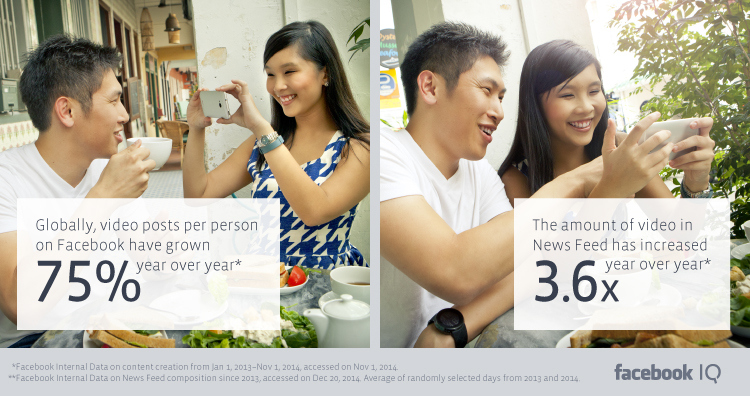
1) Last year the amount of video from people and brands in Facebook's News feed increased 3.6X year-over-year.


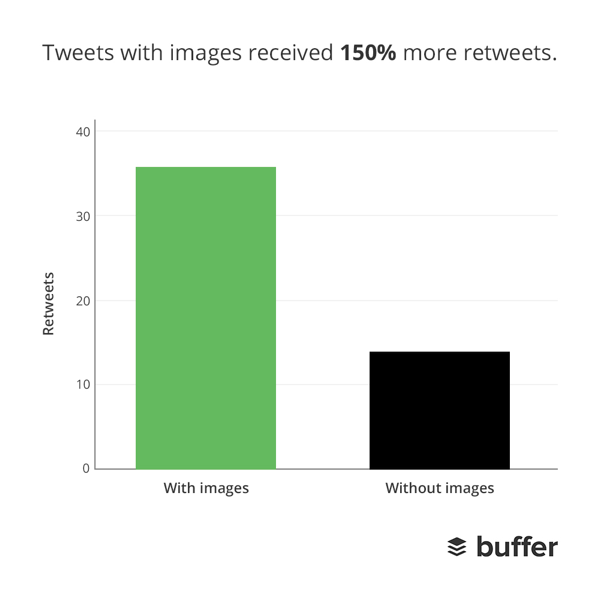
2) Tweets with images receive 18% more clicks, 89% more favorites and 150% more retweets.

3) Socialbakers.com looked at the top 10% of posts made by more than 30,000 Facebook brand pages and found that posts with photos saw the most engagement—accounting for a whopping 87% of total interactions.


4) In 2014, 39% of B2B buyers identified that they share infographics on social media frequently.


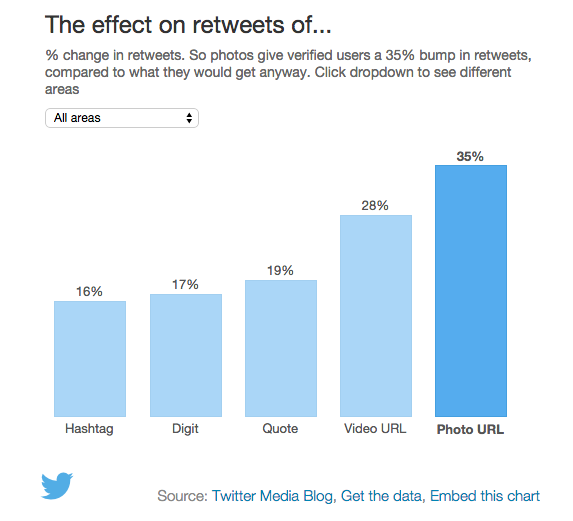
5) Adding a photo URL to your tweet can boost retweets by 35%.


Screen Shot 2015-01-16 at 12.08.51 PM.png
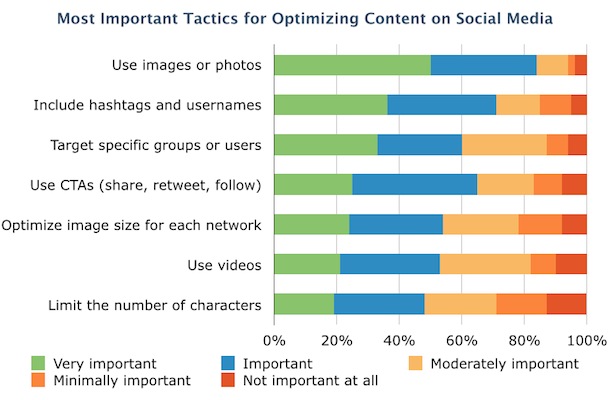
6) Images and photos are the most important tactic in optimizing social media posts.

 
Social-Optimization-Tactics.jpg


7) Visual content is a key component in each of the top 5 most effective B2B marketing tactics.


Screen Shot 2015-01-16 at 1.55.56 PM.png


8) 70% of marketers plan to increase their use of original visual assets in 2015.


Screen Shot 2015-01-16 at 12.10.12 PM.png


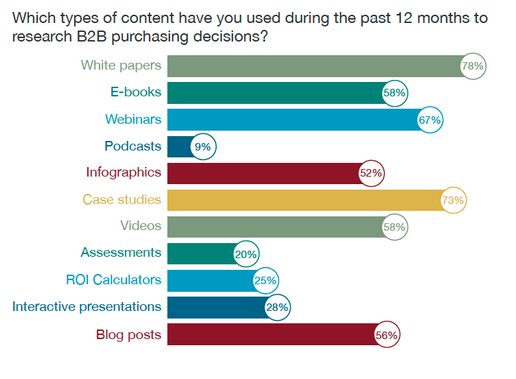
9) The top 3 content formats that B2B buyers seek out to research a purchase decision include: Whitepapers (78%), Case Studies (73%), and Webinars (67%).


Screen Shot 2015-01-14 at 4.41.55 PM.png

10) B2C marketers are more likely to use original videos (63% B2C vs. 56% B2B) and original visual assets (63% B2C vs. 56% B2B).


Screen Shot 2015-01-16 at 12.14.12 PM.png

11) 95% of B2B buyers agreed that they preferred shorter content formats.


12) In a recent study 86% of buyers expressed some level of desire to access interactive/visual content on demand.  


13) Social Media Examiner recently asked marketers which forms of content they most want to learn about in 2015. Creating original visual assets took first place, followed by producing original videos.


14) In 2014 the use of video content for B2B marketing increased by 8% to 58%, while the use of infographics topped the adoption list increasing in usage by 9% to 52%.


15) Interactive content formats such as Brainshark and SlideShare increased in popularity during 2014, up from roughly 21% in 2013 to 28% in 2014.


16) B2B marketers are employing on average 12-14 formats of content.


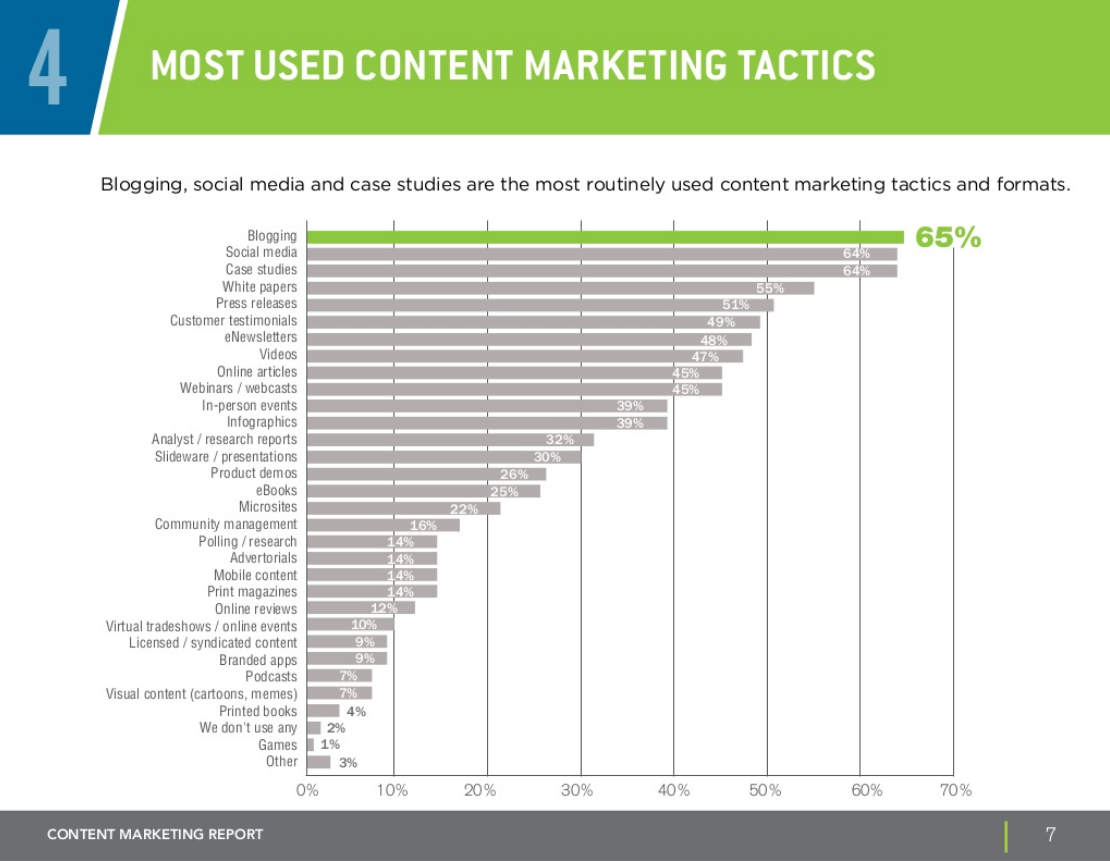
17) The popularity of whitepapers as a B2B content marketing format is actually declining in relation to more interactive, easily digestible formats such as video.


Screen Shot 2015-01-16 at 2.07.40 PM.png

Given that white papers were previously the most widely used form of marketing content for inbound marketers I might be so bold to call this shift the birth of content marketing two point zero.


Friday, 23 January 2015

7 Ways Marketers Can Get the Most out of LinkedIn

When you use the site to bolster your personal brand, you also strengthen your company's brand image.
 
LinkedIn may tag you an “All-Star” on Your Profile page—but you're a minor leaguer if you don't fully exploit the marketing and sales powers of the social medium used by more than half the world's professionals. “If your profile has the wrong information, it might as well be your tombstone,” says Mark Amtower, a consultant who specializes in LinkedIn strategy.
 
At stake are the current 313 million members, as well as the two joining per second, as LinkedIn reports. And let's not forget 3.5 million companies present there.
 
Facebook may have the B2C sex appeal, but when it comes to B2B marketing—and personal branding—LinkedIn is where it's at. Marketers can boost their own and their firm's reputations, market their wares, establish themselves and their organizations as industry thought-leaders, and harvest sales leads—with most of those benefits costing nothing.
 
“In my 30 years as a marketing consultant, I've never seen a platform that does so much,” Amtower says. “Traditional B2B direct marketers that do not fully embrace LinkedIn miss the opportunity to develop deeper relationships with key customers or be found by prospects looking for what they sell.”
 
Here are seven ways marketers can maximize LinkedIn themselves and their companies:
 
Juice Up Your Profile
 
LinkedIn Profiles average 53 million views daily. A marketer's profile should reflect that she's the face of her brand, not a job hunter. To entice prospects, marketers should share their expertise areas, the market they serve and what their company does, Amtower says. “Top the profile with a summary that's informative and fun, so it'll be read.”
 
Also upload six to 12 slides, PowerPoint presentations, or videos of your work to intrigue prospects without giving away too much to competitors, he says. And remember the basics: phone and email, so you can be easily reached.
 
Maximize Your Company Page
 
Sporadic updates aren't enough. See a company page as a mini website with appealingly packaged and SEO-jammed information, links, and contacts.
 
Look to marketing software firm HubSpot, which feeds its page almost daily with visually-adorned entries on products, achievements, new hires, and industry-related trends. It also cross-promotes the page across blogs, emails, and other channels. “We ask customers who give appreciative feedback on surveys to consider sharing their opinions on LinkedIn,” says Kipp Bodnar, VP of marketing.
 
The result: HubSpot touts 40,000 followers, 272 product recommendations, and a Culture Code slide share that's been viewed nearly 2 million times.
 
Each follower and comment packs heat, amplifying the firm's visibility on his or her own LinkedIn feed, Bodnar says:  “For us, LinkedIn traffic converts into leads more than traffic on other social platforms.”
 
Leverage Your Employees' LinkedIn Profiles and Activities
 
“Employee profiles become mini-marketing reaches that put your best face forward,” says Mike Derezin, LinkedIn's VP of sales solutions. “The more you provide, the more likely the message will be uniform.”
 
All of HubSpot's 900 employees have personal profiles and active feeds, Bodnar says. Executives set the tone by posting blog entries on their LinkedIn pages, and the firm provides profile tips, professional headshots, and a clear mission statement to new hires.
 
Join or Form a Likeminded Group
 
Sharing insights about an industry pays off: 86% of buyers say they'd engage with salespeople if they offered such knowledge, LinkedIn reports. Become a known thought leader and that rises to 92%.
 
HubSpot launched its Inbound Marketers group seven years ago, where 111,000 members currently discuss strategies and trends. Those who participate get 4 times the profile views of those who don't, Bodnar finds.
 
“Each member is a potential prospect,” Amtower says. “Useful entries also reinforce your name and brand.”
 
Use “In Messages” to Follow Those Who Check You Out
 
Look regularly to see who's examined your profile, as Amtower does thrice daily. Then pounce.
“Check out their profile, and if you see potential, reach out via message or In Mail,” he says. “You can say, ‘Hey, I saw you looked at my profile. Are you interested in chatting or connecting?' Start a conversation while it's hot—not two days later when they might not remember who you are.”
 
Use Sales Navigator to Convert Cold Calls
 
You can arm yourself with the personal information that thaws cold calls into warm introductions via LinkedIn's Sales Navigator app. Stats and analytics on targeted accounts reveal who you know in common, where workers went to school and other information, whether you're LinkedIn or not.
 
“It's hugely valuable, especially if you're B2B,” says Bodnar. “It's a lot easier to get prospects.”
 
Reach Those Who Really Matter Via LinkedIn Ads
 
Why advertise to the irrelevant? LinkedIn's display ads can target a desired audience by job title, company size, or other attributes—and HubSpot occasionally uses this feature along with its other LinkedIn efforts. “We've used some display ads in sponsored updates,” Bodnar says, “but we're advertising less on all channels, thanks to the success of nonpaid efforts, like those on LinkedIn.”


Thursday, 22 January 2015

20 Twitter Best Practices That Will Build Followers and Increase Engagement

Are you making the most out of Twitter? With over 645m users posting 790m tweets per day it’s a monster of a network and it can provide massive results when used in the right way.
 
The infographic below from Passion Digital gives you 20+ best practices to use that will help you to build new followers and increase engagement.
 
20 Twitter Best Practices That Will Build Followers and Increase Engagement


Wednesday, 21 January 2015

5 Reasons to Use Social Media Even If It’s Not Driving (Free) Traffic

Image via BigStockPhoto.com

Picture this situation: You’ve chosen the right social media platforms for your business and are posting good content to each one of them, but you’re not getting any more than just a handful of clicks.
 
How does it make you feel?
 
Frustrated!
 
But let me ask you a question: How many, of all the links that appear in your newsfeed throughout the day, do you actually click? The fact remains that you see oodles of links you don’t bother clicking. Hopefully, you’re feeling a bit relieved after this stark disclosure.
 
However, if traffic’s been dying down (especially after the recent organic reach debacle), you may need to revamp your social media marketing strategy (if you have one already) or create a new one with the assistance of an expert or an agency.
 
Today, the organic reach of Facebook page posts has reduced by a drastic 80%–90%. For example, a Facebook page like Picsity (with close to 1.3 million Likes) that regularly enjoyed a reach of 10,000 per typical post a few months back now suffers from an incredibly low reach of 500 per typical post.
 
But should you stop using social media sites because they aren’t driving your websites and blogs enough organic traffic anymore? Well, you shouldn’t (and, actually, you can’t) because there are ample reasons to be on social media other than traffic.
 
Here are five of them.
 

1. Build Relationships

 
Consistently, social media experts have reiterated that the focus should be more on “social” and less on “media.” You shouldn’t measure the worth of a social media account by the total number of its fans or followers. Social media, at its very core, is about building meaningful relationships, which depend on the quality of the conversations you have with your community. Lack of strong bonding renders even thousands of fans and followers useless.
 
In the traditional business world, organizations or companies are connected with their clients through transaction-based associations, as opposed to relationship-based associations. Relationship building gives social media platforms their uniqueness, and it’s something that traditional advertising can never achieve.
 
A few relationship building tips include:
  • Participate in conversations in a genuine way
  • Exchange original ideas with others
  • Pay attention to others’ hobbies/interests
  • Find opportunities to help others
Social media has been helping companies or business owners find partners, customers, and investors. If you approach social media as a relationship building tool, it’s still as powerful as it’s always been.
You shouldn’t measure the worth of a social media account by the total number of its fans or followers.@obaidulhaque 

2. Remain on Top of Industry News and Best Practices

 
For a business, social media is not just about tweeting or posting updates to Facebook. Recently, LinkedIn conducted a survey to understand how SMBs look at social media in regard to their businesses. 81% of the SMBs the company surveyed use social media.
 
Of this group, 94% use social media as a marketing tool. However, 49% of the surveyed SMBs admitted that they also use social media as a tool to keep themselves abreast of the latest industry news and best practices. By following other businesses, industry experts, and thought leaders, they learn more about individual niches and markets while also getting answers to many of their important business questions.
 

3. Generate Content Ideas

 
Social media sites are excellent when it comes to finding intriguing content ideas. By creating meaningful conversations of your own or simply participating in the existing ones, you’ll be able to gather a lot of ideas to create a variety of useful marketing content.
 
Copyblogger, for example, creates a discussion on LinkedIn after they’ve published a new post on their blog. This opens up opportune avenues for them to discuss a particular topic on a deeper level, engage with the audience, ask for their feedback, and collect out-of-the-box ideas for future blog posts and content in other formats.
 
The Twitter Search feature is another good tool for finding content ideas. It allows you to quickly track the trending hashtags and eavesdrop on existing public conversations for new topics and ideas. Social media websites, groups, and communities, therefore, offer you abundant material to help with the content generation process on an ongoing basis. All you need to do is turn on your social listening ears when you’re using social media sites.
 

4. Find Better Hires

 
If you don’t want to waste time digging through a pile of resumes or wading through a sea of bad candidates when planning to hire talented professionals from a specific industry, social media is your answer. According to a report published by Staff.com, as much as 92% of companies leverage platforms like LinkedIn, Facebook, and Twitter to locate, screen, and hire quality candidates for numerous job positions.
 
In an interview of 40–60 minutes, it can be quite an effort to evaluate an applicant in terms of their skills and personality. With the help of social media, however, you can quickly screen a candidate and identify the traits that could affect their performance at work. It’s crucial to note that 73% of recruiters say they have made successful hires though social media. Conversely, 1/3rd of employees also rejected applicants on the basis of what they found in their social media profiles.
There are several ways to find potential job prospects via social media, from your own social referral network to special features like Advanced LinkedIn Search. Once you’ve spotted potential candidates, you can start analyzing their social media profiles in terms of current employers, skills, work experiences, joined groups, interests, connections, quality of updates, and more.
 

5. Become More Productive

 
Being on social media, if you aren’t aware, increases productivity at work. According to a recent study by Ipsos and Microsoft, 46% of people agreed that using social media enhanced their productivity. But the result depends on what exactly you use social media websites for. If you’re checking out industry-related tweets and Facebook updates by competitors, it will certainly give your productivity level a quick boost. On the other hand, using the social platforms only for personal reasons won’t help much.
 
Don’t let social traffic become an obsession. Driving traffic to your websites and blogs should be one of the reasons to use social media, but not the only one. Change the way you look at social media, and you’ll soon see that it has a lot more to offer than you could ever expect.